

One more note on eggs
this time inside-out, with suggestive swirls
I came across the inside-out egg just a couple of years ago. It was developed in Japan nearly 250 years ago and revived around 2010. It’s a novelty preparation, and at first glance a puzzler: how can you get the white and yolk in an egg to switch places?
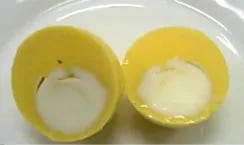
This photo and the diagram below appear in a 2021 open-source report from Professor Hajime Hatta and food-science colleagues at the Kyoto Women’s University. As they explained:
A recipe for a reversed boiled egg, the yolk inside out, was introduced in an old Japanese cookbook called “Manpou Ryori Himitsu Bako (A Treasure of Secret Recipes)” published in 1785.
The recipe of a reversed boiled egg was described as follows, “Prepare a fresh egg and pierce the eggshell by about 3 cm depth from the blunt end of the egg with a needle. Leave it in fermented, salted rice-bran paste (Luka-miso in Japanese) for three days, and then boil the egg to ensure the yolk inside out, resulting in a reversed boiled egg.”
The authors guessed that 18th-century eggs were likely fertile, and found that this was in fact a key to the recipe’s success. Once fertilized, the germ cell riding on the yolk surface begins to develop into the embryonic chick. The membrane enclosing the yolk weakens, and moisture and proteins migrate from the white across the membrane into the yolk. Here is the diagram from Hatta et al:
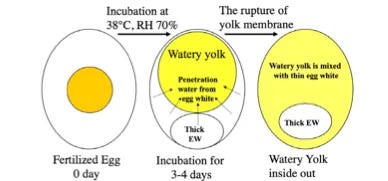
Poking a needle an inch into the egg ruptures the yolk membrane and allows the diluted yolk to flow into the remnants of the thin white, and around the remaining thick portion. Incubate the punctured egg for a few days, cook while rotating to coagulate the insides in place, and presto: an inside-out boiled egg.
Of course I had to give this a try, and was able to find fertile eggs at a couple of local markets. But I lacked an important device: an egg rotator, maternal or mechanical, which could keep the remnant white more or less centered during incubation so that the yolk can flow around it. I did turn my needled eggs occasionally, but after 3 days in a body-temperature oven, and rotation during the cooking, they ended up with an irregular mass of white off to one side of the enlarged yolk. Not recommended.
There’s a modern workaround for making inside-out eggs, apparently inspired more than a decade ago by the Hatta lab’s investigations, and already known to millions of YouTube viewers in Japan and elsewhere. No need for fertile eggs, constant rotation, or days of incubation: just a leg of stretchy hosiery and a few minutes.
The recipe: Tie a knot in the hose at its mid-length, immobilize an egg next to the knot with a twist and produce-bag tie, stretch the hose out between your hands, wind it up by tossing the egg away and then toward you in a circular motion, and then allow it to unwind, spinning the egg as it does. Repeat several times or, as some videos suggest, until you can hear the egg contents begin to slosh around. Then boil, cool, and peel.
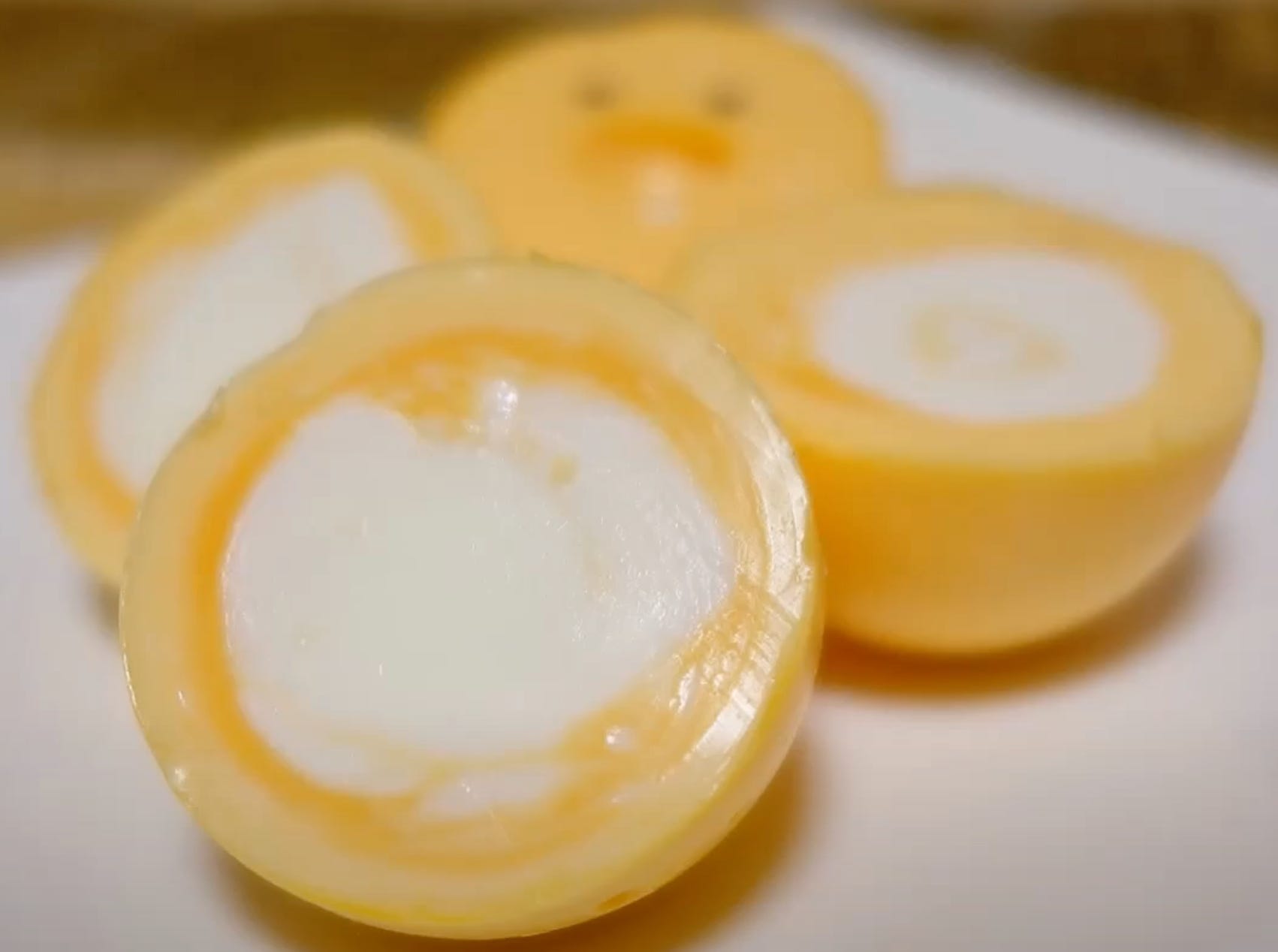
(from yama chaahan, YouTube: Reverse the yolk and white!)
How does this work? We all know from experience that the egg white and its proteins are more cohesive than the yolk and its complex dispersion of fat droplets. So spinning and the centrifugal force it exerts disrupt the yolk first, and encourage it to flow around the mostly intact white. Continued spinning disrupts the thin white, then the thick, and yolk and white gradually merge into an in-shell scrambled egg.
It can be hard to gauge how long to spin to get an intact and well-centered white, but I actually enjoy the over-spun patterns as much if not more. They give a sense of the forces and flows involved, and can be suggestively serpentine.
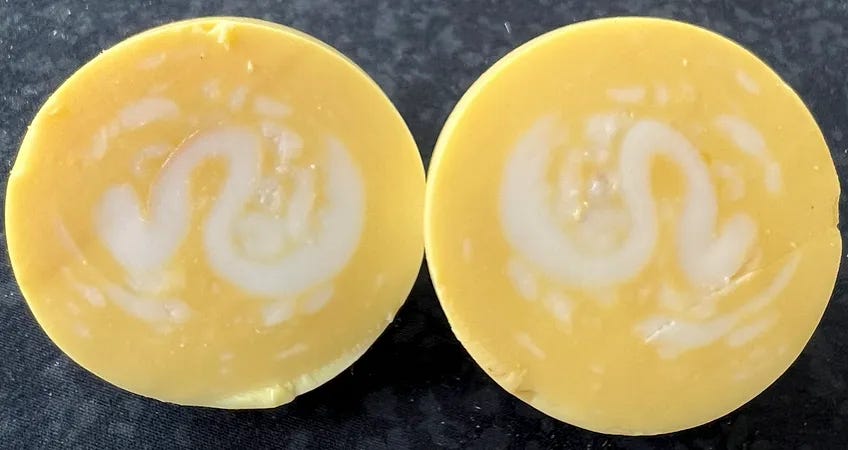
Anyone else see a dragon?
***
Hajime Hatta, Ayami Nakamoto, Yasumi Horimoto (2021). Reproduction of a reversed boiled egg (the yolk inside out) listed in an old Japanese recipe book. International Journal of Food Science and Agriculture, 5(2), 293-302. https://doi.org/10.26855/ijfsa.2021.06.013 (My thanks to Prof. Hatta for permission to reproduce two figures from this report)
yama chaahan (2004). YouTube: Reverse the yolk and white! (in Japanese, 6 minutes)
Twinkle Hoshimi Cooking Sister (2024). YouTube: The white and the yolk are reversed! (in Japanese with subtitles, for kids, 12 minutes)
I see both a dragon and a wizard 😊
That's so weird. So cool and so weird! I'm going to try it with my grandkids.